
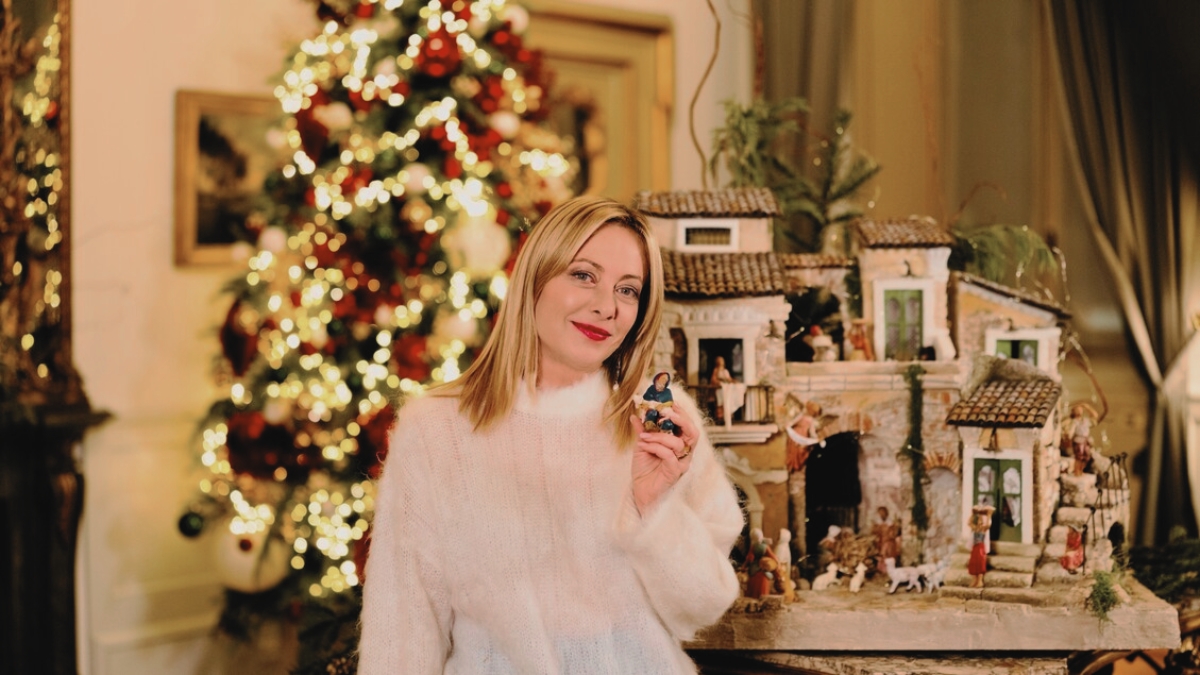
Italian Prime Minister Giorgia Meloni delivered her annual Christmas message on Wednesday from Rome, standing beside a traditional Nativity scene and calling on Italians to take pride in their cultural and religious traditions during the holiday season.
In a short video posted to social media, Meloni extended Christmas wishes to families across the country, as well as to those working through the holiday, including emergency responders, healthcare workers, and public servants. The Italian prime minister framed Christmas as a unifying moment rooted in shared history and identity.
“I want to extend a sincere wish to all Italians, to those who experience it in their families and to those who celebrate it at work,” Meloni said in the video, which was widely shared across Facebook and other platforms, according to Italy’s ANSA news agency.
Christmas Message Emphasizes Roots and Identity
Speaking beside the Nativity display, Meloni described Christmas as a reflection of Italy’s cultural foundations, referring to it as “our roots, our identity, our light.” She encouraged Italians to embrace those traditions with confidence, particularly at a time when debates over national identity and social change continue to shape political discourse.
The Christmas message, delivered on Christmas Eve, follows a pattern Meloni has established since taking office, using symbolic settings to reinforce themes of heritage and continuity. Her remarks were brief but deliberate, underscoring values she and her party have long championed.
According to ANSA, Meloni’s message was intended to strike a tone of unity, even as Italy navigates economic pressures and political divisions heading into the new year.
Nativity Scenes and Public Debate
Meloni’s appearance alongside a Nativity scene also reflects her outspoken stance on religious symbols in public spaces. The Italian prime minister has previously criticized efforts to limit or remove Nativity displays from schools or government buildings, arguing that they are cultural symbols rather than acts of exclusion.
In past remarks shared by Politico Europe, Meloni questioned why depictions of the Nativity should be considered offensive. “How can my culture offend you?” she has asked, defending public displays as expressions of Italy’s Christian civilization and historical identity.
The issue remains sensitive in Italy, where discussions over secularism, immigration, and multiculturalism frequently intersect with debates about tradition. Supporters say Meloni’s position protects cultural heritage, while critics argue it risks marginalizing non-Christian communities.
A Candid Note on the Year Ahead
In a moment that reflected her characteristically direct communication style, Meloni also offered a darkly humorous assessment of the year ahead. “2025 was tough, 2026 will be worse, don’t worry,” she said with a smile, a line that quickly drew attention online and was later shared on YouTube and Italian news outlets.
The comment was widely interpreted as an acknowledgment of ongoing challenges facing Italy, including economic uncertainty, geopolitical tensions, and domestic reforms. Still, Meloni balanced the remark with a call for serenity and resilience during the Christmas season.
Political Reactions and Public Response
Reactions to the Christmas message were mixed but engaged. Supporters praised the prime minister for what they described as a sincere and grounded message that resonates with many Italians who value tradition and national identity.
Critics, including opposition lawmakers and some civil society groups, accused Meloni of politicizing religious symbolism. Far-right leaders across Europe, they argue, often use holiday traditions to advance broader cultural narratives, a criticism highlighted by Politico Europe in previous coverage of Meloni’s leadership style.
Despite the debate, the video garnered significant engagement, underscoring Meloni’s ability to connect directly with the public through social media.
Broader Context in Italy
Italy remains a predominantly Catholic country, though church attendance has declined in recent decades. Nativity scenes, however, remain a deeply rooted part of Italian Christmas culture, displayed in homes, churches, and public squares, particularly in cities like Rome.
Meloni’s Christmas message aligns with her government’s broader emphasis on preserving Italian heritage, language, and traditions, themes that have defined her tenure as prime minister.
For additional context on Italian culture and national events, readers can explore coverage at LakeCountyFloridaNews.com, including international perspectives that connect global traditions with local communities.
Conclusion
As Italy observes Christmas Eve, Giorgia Meloni’s message highlights the enduring role of tradition in national life, even amid social and political change. Standing beside a Nativity scene, the prime minister called for pride, unity, and reflection, offering Italians a familiar message of continuity as the country prepares to enter a new year.
What’s Next: Italy’s political agenda resumes in early January, with economic reforms and European policy discussions expected to dominate Parliament in 2026, setting the stage for another challenging year ahead.
Leave a Reply
You must be logged in to post a comment.