


Every election ultimately asks voters a simple question: Can this person be trusted with the office they seek? In Orange County’s race for Clerk of Courts, that question has moved beyond campaign slogans and into the realm of legal qualification, public confidence, and governmental accountability.
Bill Moore, a retired Orlando Police Department Economic Crimes detective and candidate for Orange County Sheriff, has thrust an uncomfortable but legitimate issue into the campaign. His argument is not that individuals who have committed crimes are forever barred from public life. It is that voters deserve to know whether a candidate can legally and operationally perform every duty required of one of Florida’s most important constitutional offices.
At the center of the controversy is Clerk of Courts candidate Roberta Walton Johnson, formerly Roberta Riggins, who publicly acknowledged during a recent debate that she pleaded guilty decades ago to federal fraud-related felony offenses arising from a check fraud conspiracy. She later received clemency and restoration of civil rights, and today serves as General Counsel to the Orange County Clerk of Courts.
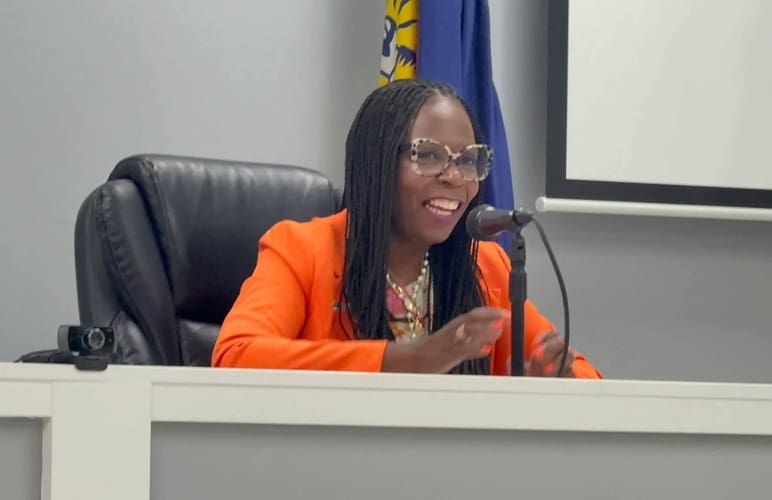 Those facts are largely undisputed. What remains disputed is whether the legal consequences of those convictions could affect her ability to fully serve as Clerk if elected.
Bill Moore argues that two unresolved questions deserve answers before – not after – Election Day.
The first concerns access to Criminal Justice Information (CJI). Bill Moore points to current FBI and FDLE Criminal Justice Information Services policies containing language stating that when a felony conviction exists, access to criminal justice information “shall” be denied. Yet Walton Johnson has publicly stated she previously operated under a limited arrangement with FDLE and has indicated she could execute the required agreements if elected.
Whether that conclusion reflects FDLE’s current legal position remains unanswered publicly. Thus far, no written legal opinion, formal determination, or official documentation has been released resolving the issue.
The second question concerns bonding.
Florida law requires Clerks of Court to obtain an official surety bond before assuming office. Bonding companies independently evaluate applicants, particularly where prior fraud or dishonesty convictions exist. Bill Moore contends that voters have not seen evidence demonstrating that the required bond has been secured or that a surety has agreed to issue one under these circumstances.
These are not trivial administrative details. They are prerequisites to holding office.
If either requirement ultimately cannot be satisfied, the consequences extend well beyond one campaign. Florida law provides mechanisms for filling vacancies, potentially resulting in gubernatorial appointment rather than the candidate chosen by voters. Regardless of political affiliation, few citizens would consider that an ideal democratic outcome.
During a recent public debate, Bill Moore asked direct questions regarding bonding disclosures and statutory eligibility. Walton Johnson responded by emphasizing her redemption, acknowledging her criminal history, and stating she could satisfy the requirements. When pressed further, however, documentation supporting those assertions was not publicly produced.
That distinction matters.
Redemption and qualification are not synonymous.
American society properly recognizes that people deserve second chances. Clemency restores important civil rights. But restoration of rights does not automatically resolve every statutory, fiduciary, or security requirement attached to every public office. Certain positions – particularly those involving criminal justice information, financial responsibility, and constitutional authority – carry obligations extending beyond electoral popularity.
This controversy should not become a referendum on mistakes made three decades ago. Nor should it devolve into personal attacks. It should instead become exactly what elections are intended to encourage: rigorous public examination of whether every candidate can fully discharge every duty of the office sought.
Transparency is not punishment.
Accountability is not persecution.
And asking difficult questions before voters cast their ballots is not “negative campaigning.” It is precisely how representative government is supposed to function.
Orange County voters deserve more than assurances. They deserve documentation. If the answers ultimately support Walton Johnson’s eligibility, the issue disappears. If they do not, voters have every right to know before – not after – they elect one of the county’s most important constitutional officers.
Democracy depends not merely upon elections, but upon informed elections. When legitimate legal questions remain unanswered, silence serves no one – not the candidates, not the courts, and certainly not the voters.
The post Orange County Clerk Race Tests Difference Between Redemption and Qualification appeared first on West Orlando News.
Source: West Orlando News
Published: 2026-07-27 16:25:00