
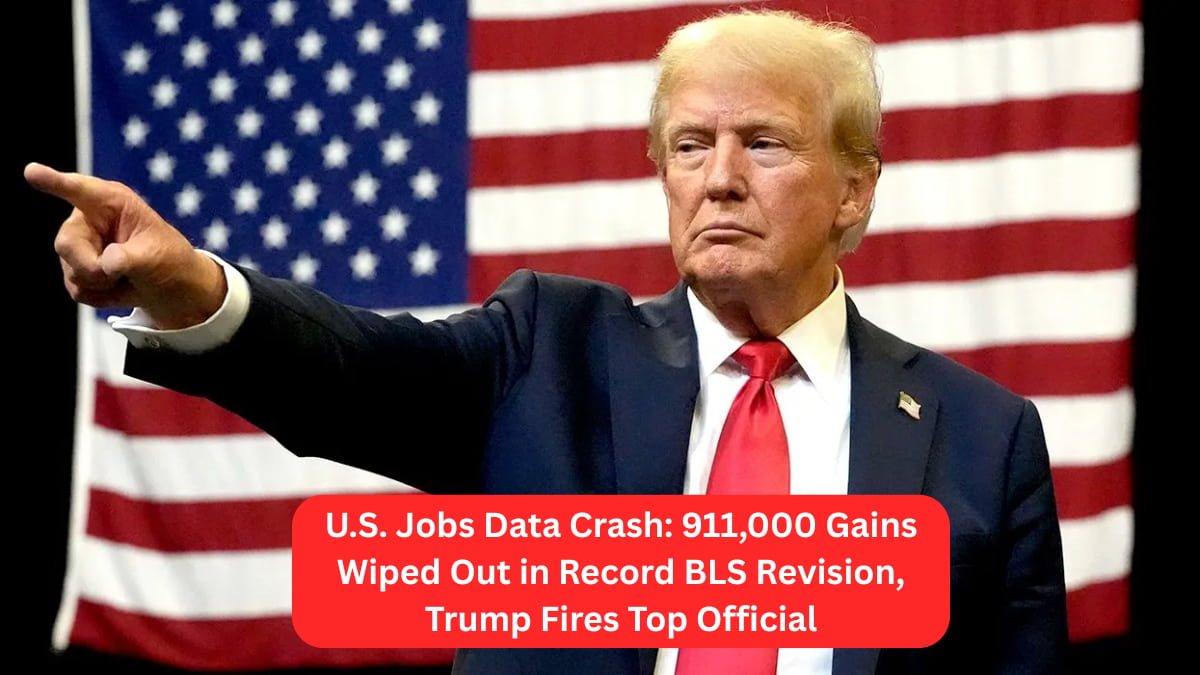
A Historic Blow to the U.S. Economy
In a seismic shock to America’s economic confidence, the U.S. Bureau of Labor Statistics (BLS) announced on September 9, 2025, a historic downward revision, erasing 911,000 jobs from the record books for April 2024 to March 2025.
The revision — the largest in U.S. history — has cast doubt on the Biden administration’s economic narrative and fueled fierce debate in Washington, Wall Street, and beyond.
The Historic BLS Revision: What Went Wrong?
The annual BLS benchmark revision slashed nonfarm payroll estimates by 911,000 jobs, nearly double the previous record adjustment of 501,000 in 2009.
Sectors hardest hit:
- Leisure and hospitality
- Professional services
- Retail
The revision came after BLS compared its monthly surveys with unemployment insurance records, uncovering a massive disconnect. While previous reports suggested steady job growth, the new data shows little change since April.
Critics accuse the Biden administration of painting an overly rosy picture, with some even suggesting political manipulation of jobs data.
Trump’s Bold Response: Leadership Shakeup
On September 10, 2025, President Donald Trump wasted no time. He:
- Fired BLS Commissioner Erika McEntarfer (a Biden appointee)
- Nominated E.J. Antoni, a conservative Heritage Foundation economist, as her replacement
In a post on X (formerly Twitter), Trump blasted the revision as “a disgraceful cover-up exposed” and pledged “transparent economic reporting under new leadership.”
Supporters hailed the move as long overdue, while labor unions and Democrats accused Trump of politicising the data.
Federal Reserve and Wall Street Fallout
The revision has increased pressure on the Federal Reserve to cut interest rates. With rates currently at 4.25%–4.50%, analysts predict a quarter-point cut as early as September 2025.
- New York Fed President John Williams had already hinted on September 4 at possible cuts if unemployment rose — a scenario now more likely.
- Wall Street reacted immediately, with the Dow Jones falling 300 points on September 9.
Economists warn that trust in U.S. data may erode further, with ripple effects on global markets.
Local Impact in Lake County, Florida
The shockwaves extend to Lake County:
- The leisure and hospitality sector — one of the county’s largest employers, especially in Clermont and Leesburg — is among the hardest hit.
- Retail and professional services jobs could also be at risk.
- Families already strained by rising costs now face the risk of slower hiring or even layoffs.
For a community dependent on tourism and services, the jobs data crash feels very real.
Media and Public Reaction
The revision has dominated headlines and trended on X with hashtags like #JobsDataCrash and #BidenEconomy.
- Rep. Marjorie Taylor Greene tied the collapse to broader policy failures.
- Elon Musk echoed concerns about media silence, similar to his role in the Iryna Zarutska murder case, highlighting X’s role as a driver of public debate.
What’s Next for the U.S. Economy?
- The BLS will release a full sector breakdown on September 15.
- Trump’s administration may push emergency economic measures.
- The Fed could move sooner than expected on rate cuts.
Uncertainty looms as Americans brace for the next wave of economic news.
Call to Action
What’s your take on the 911,000 jobs wiped from U.S. data? Do you think rate cuts will stabilize the economy, or is deeper reform needed?
Share your thoughts in the comments and join the conversation on our social media.
Bookmark Lake County Florida News for breaking updates on the jobs data crash, local economic impacts, and national policy shifts.
Leave a Reply
You must be logged in to post a comment.